Belts Totally Matter: A Data Driven Breakdown
We compared 19,000+ competitors to measure how much BJJ belts actually overlap.

We and the whole internet have been there a million times.
“How come my buddy who started at the same time as me got promoted before me?”
“I’m a blue belt and I just tapped out my first black belt.” - Reddit thread (one of many)
“A hobbyist blue belt will never be able to compete at the same level as blue belts who train professionally/full-time. That being said, the AOJ kids wrecking blue belts divisions right now have both been training over 10 years...longer than some actually competitive black belts.” - Reddit comment
Fundamentally, what we’re all really asking is: Do belts even matter?
Most of us want them to matter. We work hard, we want recognition, and belts are one of the main ways jiu-jitsu measures progress. But belts are also subjective, inconsistent between gyms, and influenced by things like age, training volume, competition focus, and athleticism.
A new rating system
Luckily, we now have a way to objectively compare athletes across belts using ELO ratings.
JiuJitsu.net assigns ratings to competitors based on IBJJF match results. Every time Athlete A beats Athlete B, A gains rating points and B loses rating points. Beating a highly rated opponent gives you a bigger increase than beating a lower rated one.
The system has tracked hundreds of thousands of IBJJF matches since No-Gi Worlds 2024. The details are complicated, but the important part is simple:
We now have a way to compare the competitive performance of athletes across different belts and divisions.
When we look at the averages, the belts make perfect sense.
On average:
blue belts rate higher than white belts,
purple belts rate higher than blue belts,
brown belts rate higher than purple belts,
and black belts rate higher than brown belts.
So yes, belts do correlate strongly with skill.
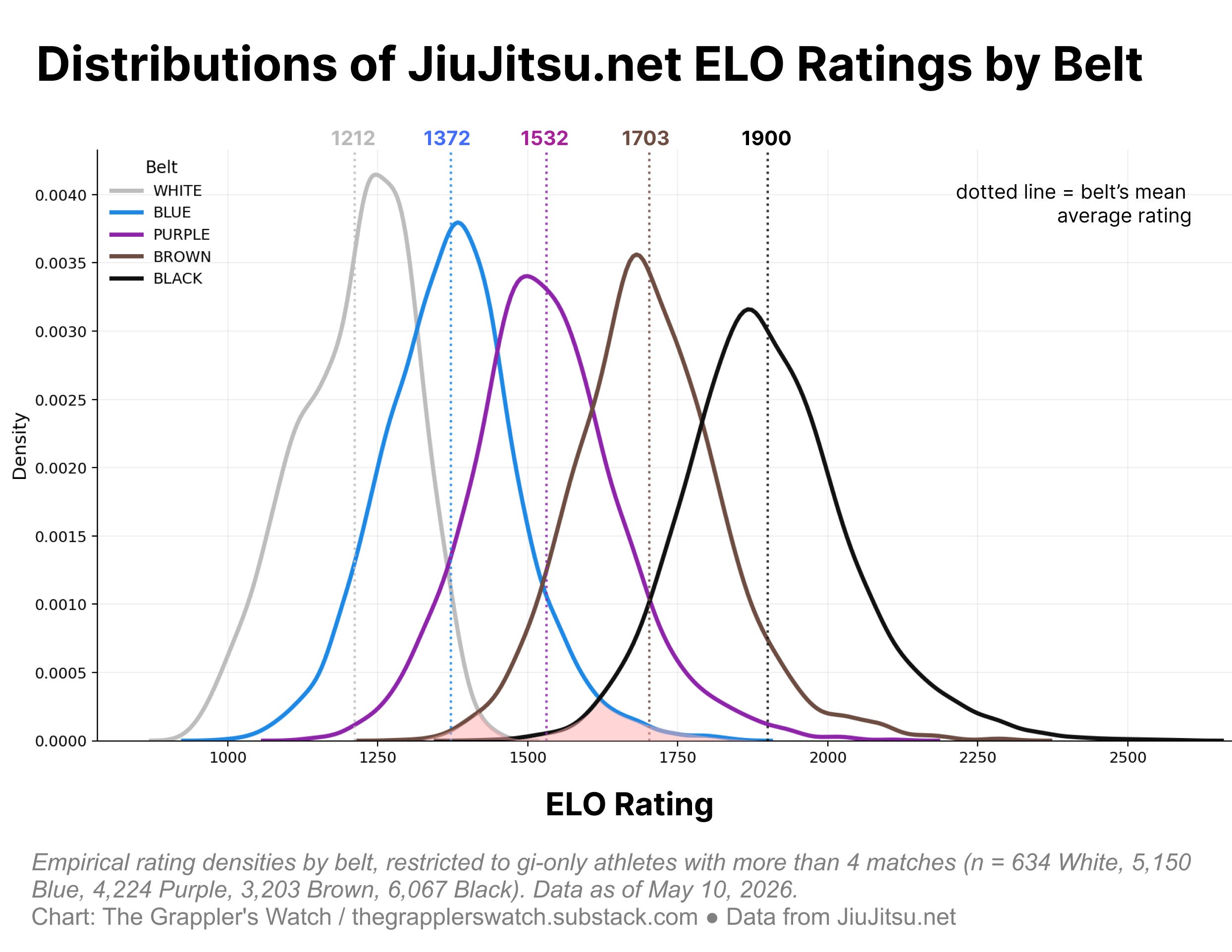
But things get much more interesting when we graph the full distributions.
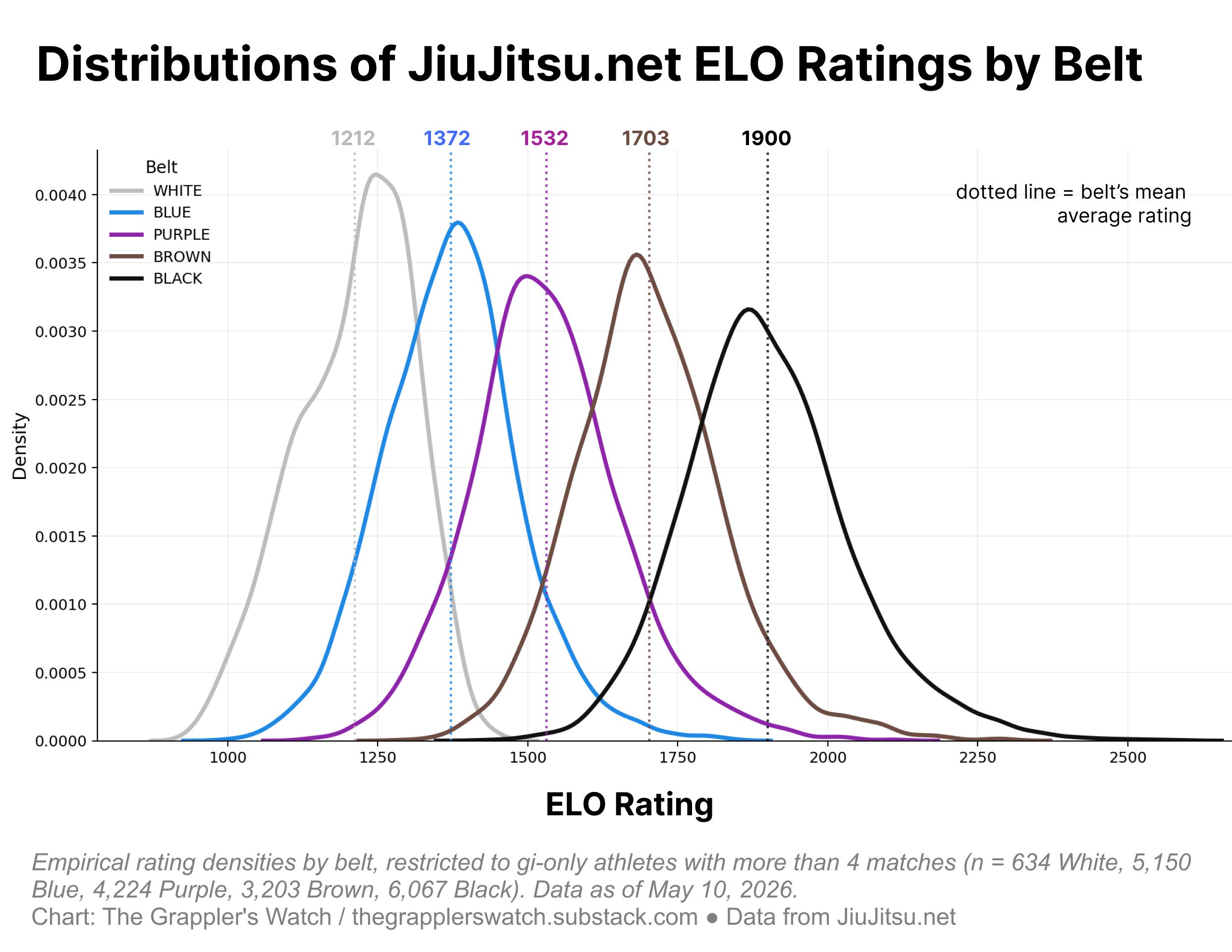
Right away, we can see that every belt has a huge spread of ratings. Even within a single belt, athletes can differ by 500–1000 rating points.
That means belts are not cleanly separated categories. They overlap.
Here’s the overlap between white and blue belts:
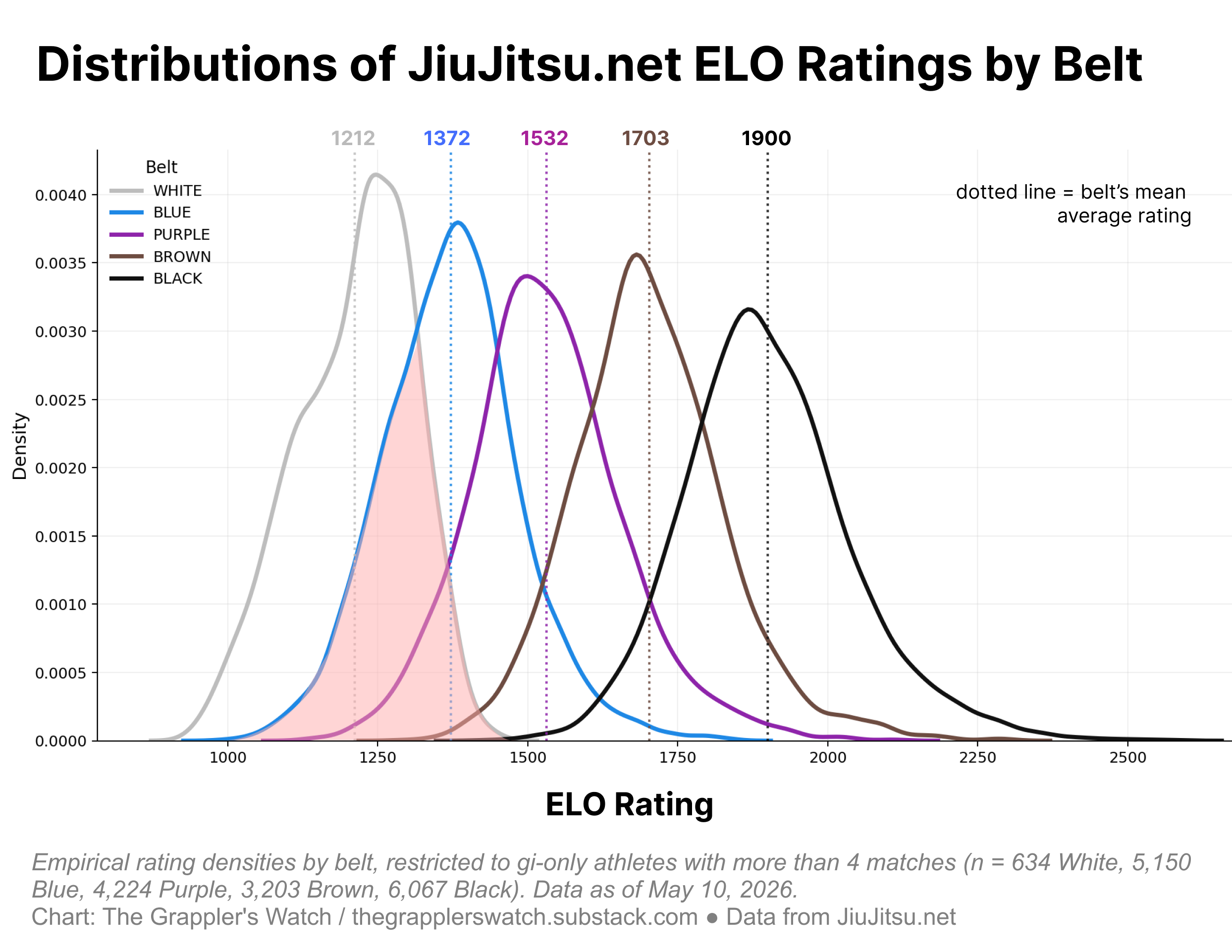
The overlap area between these curves is 0.29. In plain English:
If you watched random competitors rolling without seeing their belts, about 29% of the time their skill ratings alone would not clearly tell you whether they were a white belt or blue belt.
Or more simply:
Sometimes a really good white belt genuinely looks like a blue belt.
Sometimes a newer blue belt genuinely looks like a white belt.
That overlap is normal.
We can do the same analysis for every adjacent belt combination:
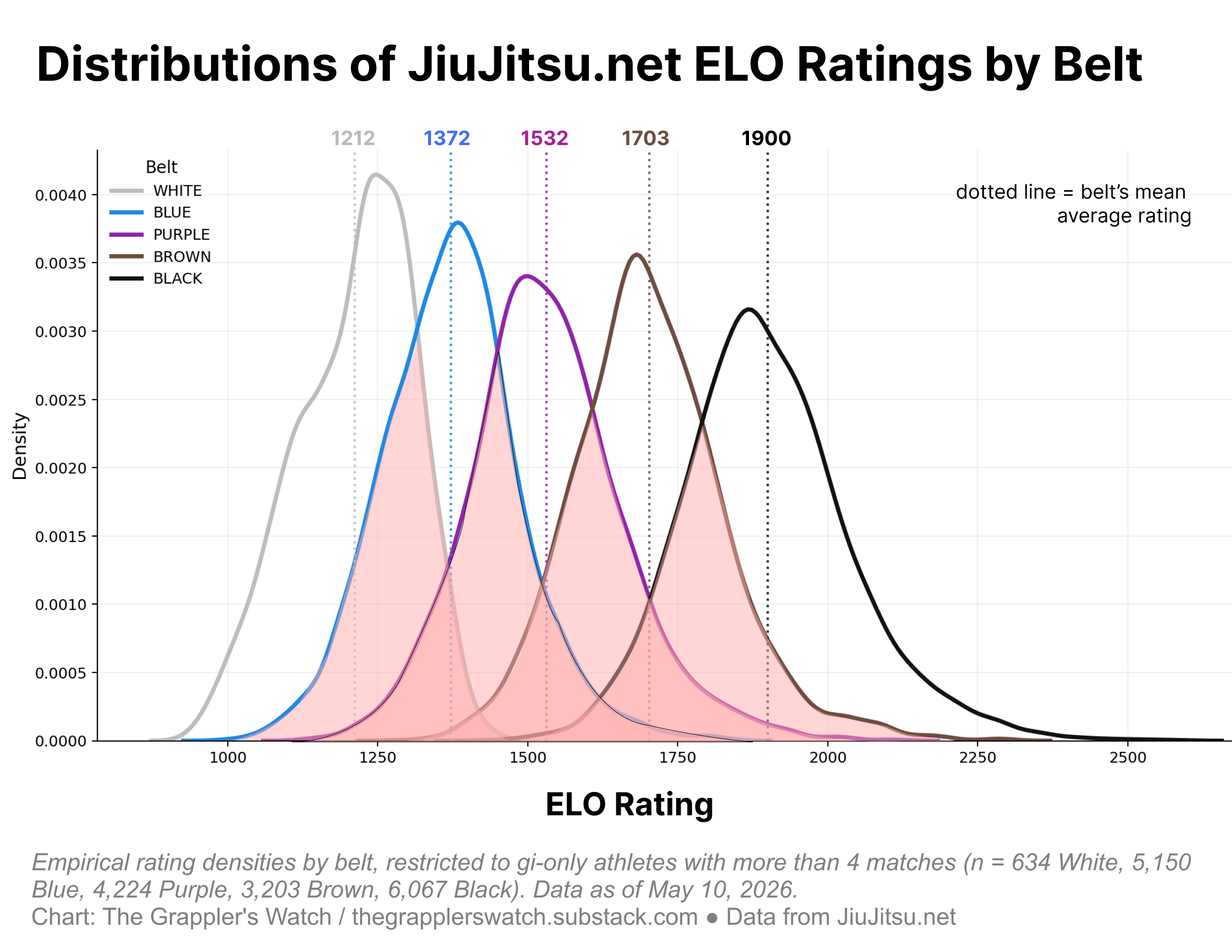
Which gives us:
White vs Blue: 29% overlap
Blue vs Purple: 40% overlap
Purple vs Brown: 41% overlap
Brown vs Black: 39% overlap
That means if you watched random competition footage without belt colors:
29% of the time, a white belt and blue belt could look comparable
40% of the time, a blue belt and purple belt could look comparable
41% of the time, a purple belt and brown belt could look comparable
39% of the time, a brown belt and black belt could look comparable
We can push this even further…
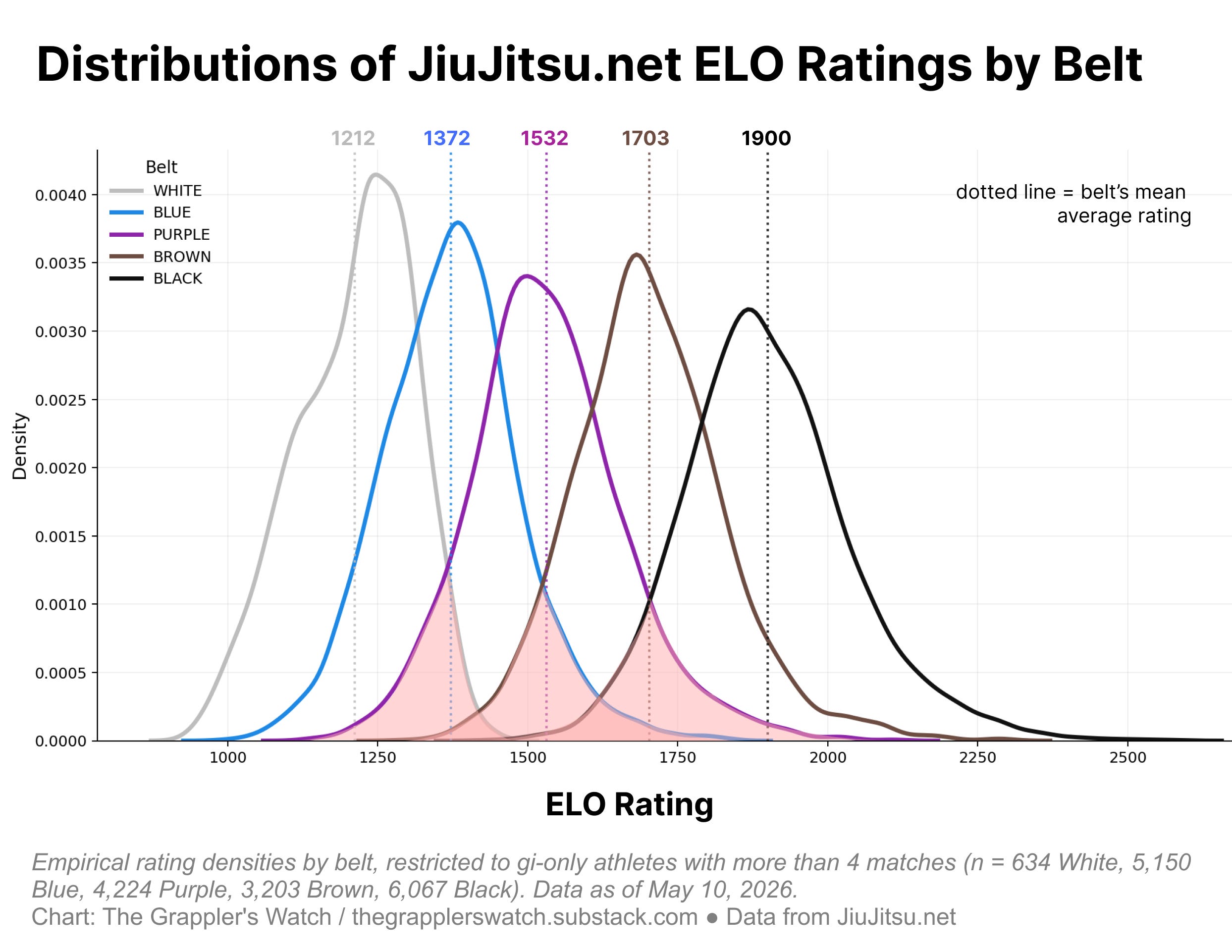
Even non-adjacent belts still have measurable overlap:
White vs Purple: 6%
Blue vs Brown: 8%
Blue vs Black: 10%
Meaning:
Sometimes an exceptional lower belt can perform similarly to an underperforming higher belt.
Finally, when we compare belts that are very far apart:
Effectively, if you watched random people rolling in competition without seeing their belt:
0.4% of the time you genuinely couldn’t tell if someone was a really, really good white belt or an “underperforming” brown belt
1% of the time you genuinely couldn’t tell if someone was a really, really, really good blue belt or an “underperforming” black belt
In case you’re wondering, the overlap of white and black belts in this dataset is 0.02%.
So… Do Belts Matter?
Belts do not tell you exactly how good someone is. They tell you the range they probably belong in. A belt is not a guarantee that one person beats another, but a statistical indicator of long-term skill.
Humans improve continuously. Belts change instantly. There is no magical moment where someone suddenly becomes “blue belt level” overnight. Skill develops gradually, while promotions happen on specific days. That naturally creates overlap.
So if a blue belt loses to a white belt? Not shocking.
If a purple belt taps a black belt? Also possible.
And if your training partner got promoted before you even though you can still beat them? You might just be sitting in that overlap region.
About the data
Thanks to Will Weisser and JiuJitsu.Net for providing the rating data for this project. JiuJitsu.Net ranks competitors and provides a comprehensive database of matches in events run by the International Brazilian Jiu-Jitsu Federation. It is an independent site and are not affiliated with the IBJJF.
This data comes from roughly 4.5 years of competition rating history across multiple belt levels. The ratings are not a perfect measurement of skill: promotions, activity levels, and limited match data can all influence where someone lands on the curve. For example, promoted athletes receive bonus rating points to help account for skill growth between competitions.
So while the exact peaks of each belt may not be perfectly “natural,” the important pattern is still very clear: belt skill ranges overlap heavily. The goal of this analysis is not to create a flawless ranking of grapplers, but to visualize how skill distribution actually works across belts in the real world.
The problem is look at top nogi purple belts in the system. They are slightly above average black belts according to the ELO.
If the system was well calibrated, there would not be a need to do a “promotion bonus” when people move up.
It’s a good system but under states how good top purple belts are. And probably over rates less competitive black belts.
Especially in nogi.
The K factor isn’t high enough for top guys to catch up.
This was a great read.